Trie
A detailed explanation of the Trie data structure with examples and use cases.
What is a Trie?
A Trie (pronounced as "try") is a tree-based data structure that stores strings efficiently for fast search, insertion, and deletion. Each node represents a single character, and paths in the tree represent words. Tries are particularly useful for prefix-based problems, such as autocomplete and dictionary lookups.
How a Trie Works
Each node in a Trie contains:
- Character: The value stored in the node.
- Children: References to child nodes (next characters in the word).
- End of Word Marker: A flag to indicate if the node marks the end of a word.
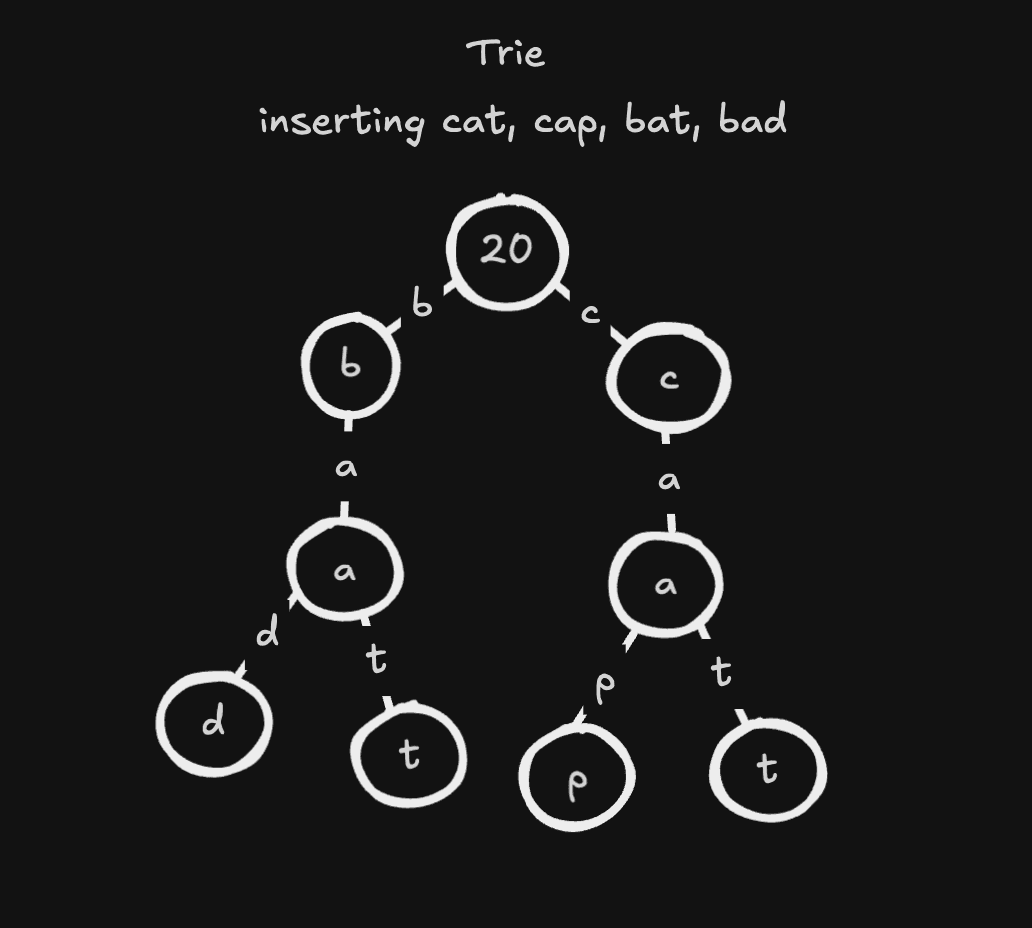
Tries build words character by character, where a single root node branches out for each possible starting character.
Here’s an example of how the Trie looks after inserting the words: cat, cap, bat, and bad.
Key Operations on a Trie
Note
m is the length of the word, p is the length of the prefix and n is the number of child nodes traversed.
Insertion O(m)
Inserts a word character by character. If a character doesn't exist as a child, it creates a new node.
Search O(m)
Checks if a word exists by traversing the tree character by character.
Prefix Matching O(p + n)
Efficiently finds all words starting with a given prefix.
Applications of Tries
Tries are widely used in:
- Autocomplete systems (like search engines and text editors).
- Spell checkers and dictionary lookups.
- IP routing (used in networking).
- Pattern matching for strings and text processing.
Tries are efficient for operations involving prefixes, making them indispensable in various real-world applications.
Code Examples
Here are examples of basic Trie operations in Python, C++, and Java.
#include <iostream>
#include <unordered_map>
using namespace std;

class TrieNode {
public:
    unordered_map<char, TrieNode*> children;
    bool isEndOfWord;

    TrieNode() {
        isEndOfWord = false;
    }
};

class Trie {
private:
    TrieNode* root;

public:
    Trie() {
        root = new TrieNode();
    }

    // Insert a word into the Trie
    void insert(string word) {
        TrieNode* node = root;
        for (char ch : word) {
            if (!node->children.count(ch)) {
                node->children[ch] = new TrieNode();
            }
            node = node->children[ch];
        }
        node->isEndOfWord = true;
    }

    // Search for a word in the Trie
    bool search(string word) {
        TrieNode* node = root;
        for (char ch : word) {
            if (!node->children.count(ch)) {
                return false;
            }
            node = node->children[ch];
        }
        return node->isEndOfWord;
    }

    // Check if any word starts with a given prefix
    bool startsWith(string prefix) {
        TrieNode* node = root;
        for (char ch : prefix) {
            if (!node->children.count(ch)) {
                return false;
            }
            node = node->children[ch];
        }
        return true;
    }
};

// Example usage
int main() {
    Trie trie;
    trie.insert("cat");
    trie.insert("cap");
    trie.insert("bat");
    trie.insert("bad");

    cout << trie.search("cat") << endl; // Output: 1 (true)
    cout << trie.startsWith("ba") << endl; // Output: 1 (true)
    return 0;
}